
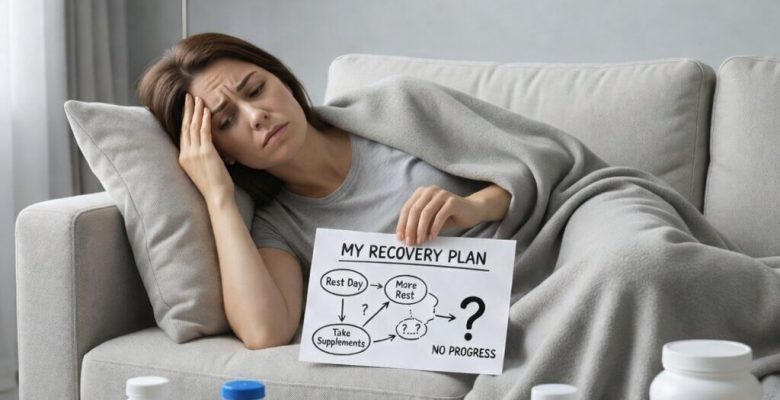
Why Rest, Supplements, and “Doing Less” Aren’t Helping You Recover
If rest actually fixed overload, you’d already be better.
You’ve slowed down. You’ve canceled plans. You’ve taken time off. You’ve added the supplements. The ones meant to calm the fire, support your adrenals, balance your frayed nervous system.
And yet.
Your body still doesn’t feel stable.
That gap — between everything you’ve done and how you still feel — is one of the most discouraging places to live. Because you’re not lazy. You’re not ignoring it. You’ve been trying, maybe harder than anyone around you even knows.
The problem isn’t that rest or supplements don’t matter. It’s that they can’t solve the real issue on their own.
The Park We Never Made It To
I was eight years old. We were supposed to go to the park.
My mom wasn’t feeling well. Again.
My dad, worn down by years of canceled plans and no real answers, said what a lot of people said back then. “It’s all in your head.” My mom broke down crying and went to the bedroom.
I didn’t understand what was happening to her body. I just knew something was wrong. I brought her cookies and milk and told her it would make her feel better.
She hugged me. Apologized for not feeling well. Promised we’d try again tomorrow.
We didn’t make it to the park that day. And scenes like that — quiet cancellations, plans postponed, energy just gone — shaped the rest of my life.
What I know now, looking back, is that she had rested. She wasn’t out late. She wasn’t ignoring her body. She was doing everything you’re supposed to do.
It still wasn’t enough.
It wasn’t weakness. It wasn’t imagination. It was overload.
Her system was carrying more than it could recover from. And rest alone couldn’t fix that.
Why “Doing Less” Feels Logical — But Falls Short

When symptoms escalate, pulling back makes sense. Your body feels depleted. Stimulation feels overwhelming. Activity seems to make things worse.
So you reduce demand.
But here’s the catch.
Reducing demand doesn’t automatically rebuild capacity.
It just lowers the immediate load.
That’s why you might feel:
- Slightly better… but fragile
- Calmer… but not resilient
- Rested… but not restored
There’s a difference between a body that paused and a body that healed. Rest alone only gives you the first one.
What’s missing isn’t more rest. It’s recovery rhythm — the system’s ability to load, clear, and return to baseline on its own. When that’s gone, no amount of stillness brings it back.
Rest Is a Pause — Not a Reset
Rest gives the body a break. It does not teach the system how to recover predictably.
Think about what happens to a phone that never fully charges. You plug it in. It climbs to 60 percent. You use it. It drops fast. You plug it in again. Same result.
The problem isn’t the charging. The problem is something in the system that won’t hold the charge.
That’s what’s happening in your body.
When your nervous system doesn’t know how to return to baseline:
- It stays alert even during rest
- It treats stillness as temporary
- It never fully downshifts
That’s why people say:
“I rested all weekend and still feel off.” “I sleep, but I don’t feel recovered.”
The system paused. It didn’t recalibrate.
Why Supplements Can’t Create Stability

Supplements can be supportive. But they work best when the system they’re supporting is already stable.
When your recovery capacity is low, supplements start doing something strange.
- Effects feel inconsistent
- Benefits wear off quickly
- Adding more creates confusion instead of calm
- You start chasing the next solution
This isn’t because the supplements are bad. It’s because they can’t replace regulation.
They assist function. They don’t rebuild it.
Pouring good fuel into an engine that can’t regulate its own temperature doesn’t fix the engine. It just gives you a better-fueled breakdown.
The Real Problem: Lost Recovery Rhythm

Here’s what nobody tells you when they hand you a pill or a pamphlet about rest.
The deeper issue isn’t fatigue.
It’s that your body has lost its recovery rhythm.
A healthy system runs a predictable cycle. It loads during the day. It clears at night. It returns to baseline. It repeats.
When that rhythm breaks, everything else breaks with it:
- Rest feels shallow
- Sleep isn’t restorative
- Symptoms linger past when they should
- The body never fully resets
You’re not stuck because you’re weak. You’re stuck because the rhythm that used to carry you through has gone quiet.
And “just rest” can’t restart what it didn’t break.
Why Pulling Back Further Can Actually Slow You Down
This one is uncomfortable. But it’s important.
If you only reduce input — without rebuilding capacity — the system never learns it’s safe to expand again.
Over time:
- Tolerance shrinks
- Sensitivity increases
- Confidence erodes
- Life contracts
Not because you’re doing something wrong. But because capacity isn’t being trained.
The same way a muscle atrophies when it’s never asked to engage, your nervous system loses its range when it’s never gently asked to expand.
You aren’t broken. You’re undertrained in a very specific way.
Recovery Requires Structure — Not Just Stillness

True recovery happens when the body experiences something specific.
Not silence. Structure.
- Predictable inputs
- Safe expansion
- Successful return to baseline
- Repetition without crash
That’s how the nervous system relearns what it forgot.
“I can handle this.” “I come back.” “I’m safe again.”
Stillness alone doesn’t teach that lesson. Structure does.
What Actually Moves the Needle
Real recovery has a foundation. It starts with:
- Baseline stability — before anything else
- An environment that reduces background load
- Nervous system regulation, not just nervous system suppression
- Gradual capacity expansion
- Clear recovery signals
When those are in place, something shifts.
Rest becomes restorative. Supplements become supportive. Activity becomes possible again.
Not because you pushed harder. But because the system rebuilt its trust in itself.
If You’ve Been Pulling Back for a Long Time
If you’ve felt like:
“I’ve done everything I can to rest.” “I don’t know how to do less than this.” “I’m afraid to add anything back.”
You’re not failing recovery. You’re missing its structure.
Healing isn’t about stopping life. It’s about teaching your body how to move through it again.
And the first step isn’t doing more.
It’s learning to read the signals.