The Hidden Toxins in Everyday Personal Products
Why Your Body Feels Overloaded — and What to Do About It
Most people believe allergies, inflammation, and chronic symptoms are caused by obvious triggers — pollen, dust, or certain foods.
But there’s another category of exposure that quietly adds pressure to the body every single day.
Your personal care products.
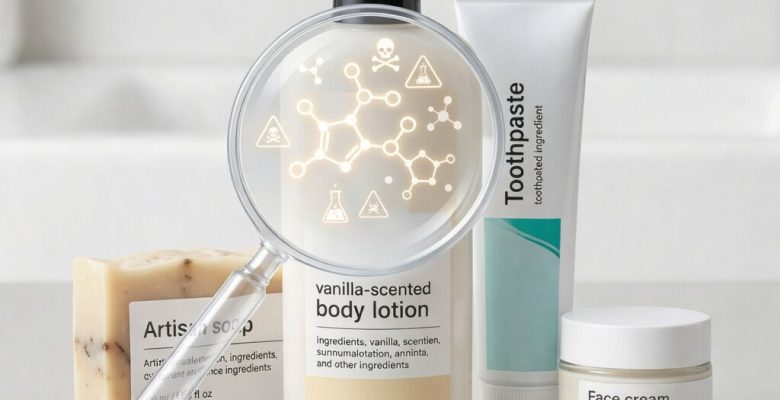
Shampoo. Deodorant. Body lotion. Fragrance. Hair spray.
The average person uses 10 to 20 of them every day. Ten to twenty. Without ever reading a label. Without ever asking what’s inside.
The Real Problem: It’s Not One Exposure — It’s Total Load
Your body does not experience exposures one at a time. It experiences them as a total load.
A little fragrance here. A preservative there. A solvent in another product.
Individually, these may seem insignificant.
But combined — and repeated daily — they create a constant level of background pressure on your system.
This is a core principle within the Quick Think Formula™:
When total load exceeds your body’s capacity, symptoms appear.
Not randomly.
Predictably.
How Overload Shows Up in the Body
When this background pressure builds, the body begins to respond.
You may notice symptoms such as:
- Headaches
- Sinus congestion
- Fatigue
- Brain fog
- Skin irritation
- Hormonal disruption
- Increased immune sensitivity
Most people attempt to treat these symptoms directly.
But the real issue often sits underneath them:
Unseen, cumulative exposure.
Why Your Skin Is Not Just a Shield
Personal care products are unique because they are applied directly to the body.
Your skin is not just a protective barrier — it is also an absorption surface.
And many of the chemicals in these products were never tested for long-term, daily, multi-product use. They were approved one at a time. Not stacked. Not repeated 365 days a year.
But that’s exactly how you use them.
The 5 Hidden Ingredients That Quietly Add Pressure
Not every ingredient is harmful on its own.
The issue is cumulative exposure across multiple products, every day.
Here are five categories worth paying attention to:
- Fragrance “Fragrance” is not a single ingredient. It can represent dozens or even hundreds of undisclosed chemicals. For sensitive individuals, it is one of the most common hidden triggers.
- Parabens Used as preservatives in lotions, cosmetics, and shampoos. Some research has raised concerns about their potential impact on hormone balance.
- Phthalates Often used to stabilize fragrance. Common in perfumes and sprays, and associated with respiratory irritation and hormonal effects in some individuals.
- Formaldehyde Releasers Certain preservatives slowly release formaldehyde over time. Examples include:
- DMDM hydantoin
- Quaternium-15
These can contribute to skin irritation and sensitivity.
- Triclosan Previously used in antibacterial products. Although reduced in use, it still appears in some items and has raised concerns related to hormone disruption and microbial resistance.
Why Some People React More Than Others
You’ve probably seen this before.
One person can tolerate scented products all day without issue. Another walks into the room and immediately feels it — the pressure behind the eyes, the tightening in the chest, the fog rolling in.
It’s not weakness. It’s not anxiety. It’s not in your head.
It’s capacity.
The Capacity Model
Every body has a limit to how much stress and exposure it can handle.
- Some people have a high capacity
- Others are already operating near their threshold
When capacity is reduced, even small exposures can trigger symptoms.
What Lowers Your Capacity
Capacity is not fixed — it changes based on your overall load.
Common factors that reduce tolerance include:
- Poor sleep
- Chronic stress
- Inflammation
- Mold or environmental exposure
- Nutritional deficiencies
- Seasonal allergies
When these stack together, the system becomes more reactive.
The Domino Effect
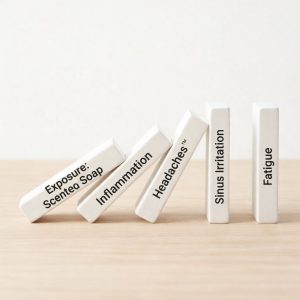
This is how it happens.
Not all at once. Not dramatically.
One exposure tips the next. And suddenly you’re down — and you don’t even know which domino started it.
A single exposure can trigger a chain reaction:
Perfume exposure → Sinus irritation → Headache → Fatigue → Brain fog
It’s not one symptom — it’s a sequence.
And it often starts with a level of background load that was already too high.
The Solution: Reduce Load, Rebuild Capacity
The goal is not to eliminate every possible exposure.
That approach is unrealistic — and unsustainable.
The real strategy is:
- Lower total exposure load 2. Rebuild your body’s capacity
When both happen together, the system becomes significantly more stable.
Where to Start (Without Getting Overwhelmed)
Give yourself permission to start small.
One of the biggest mistakes people make is trying to change everything at once. That almost always leads to burnout and failure.
Instead, focus on the products that create the largest daily skin contact:
- Deodorant
- Lotion
- Shampoo
- Laundry detergent
- Perfume or fragrance
Switching just these can dramatically reduce your overall chemical load.
What to Look For in Safer Alternatives
When choosing replacements, keep it simple. Look for products that are:
- Fragrance-free
- Dye-free
- Made with simple ingredient lists
- Lower in preservatives
In many cases:
The simplest products are the safest.
Don’t Chase Perfection — Reduce Pressure
You do not need to be perfect to see results.
This is critical.
Even a 20–30% reduction in total exposure can lead to noticeable improvements in:
- Stability
- Energy
- Clarity
- Symptom frequency
Small changes create momentum.
And momentum creates transformation.
Final Perspective
Your symptoms are not random.
They are signals.
Signals that your system may be carrying more load than it can currently handle.
By reducing hidden exposures — especially from everyday personal products — you begin to lower that pressure.
And when pressure decreases:
The body often stabilizes faster than expected.