

The Hidden Reason Your Body Can’t Calm Down — Even When Tests Come Back “Normal”
Clear labs. Normal scans. Nothing “wrong” on paper.
And yet your body still won’t settle.
You’re exhausted. Reactive. Foggy. Wired but can’t sleep. You feel it every single day — this low hum of something being off — and then you go looking for answers, and the data says you’re fine.
That gap between what the tests say and what you feel is one of the most disorienting places a person can live.
It leads most people to the same quiet question:
Is this in my head?
It’s not.
What “Normal” Tests Actually Measure — And What They Miss
Medical tests are built to answer one question: Is there damage happening right now?
They’re very good at finding it.
- Organ damage
- Acute inflammation
- Structural problems
- Severe deficiencies
- Clear autoimmune markers
But damage is only half the picture.
What they can’t measure — what nobody ever tells you about — is whether your body is regulating itself.
You can pass every test and still have a system that’s stuck in survival mode.
The Missing Piece: Regulation vs. Damage
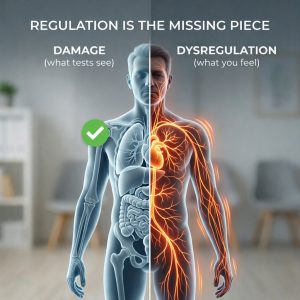
Here’s the distinction most people are never taught.
Damage is something medicine can see clearly. Dysregulation is something you feel long before damage appears.
Think about what that actually looks like on a Tuesday afternoon.
You didn’t sleep badly. You didn’t eat anything unusual. But by 2pm your thoughts are slow, your eyes feel like sandpaper, and your skin is doing that thing again. Nothing “happened.” And yet here you are.
That’s not damage. That’s a body that can no longer downshift.
A body that is:
- Overstimulated
- Overloaded
- Slow to recover
- Reacting to small things as if they’re emergencies
It doesn’t show up on a scan. But it shows up in your life — in the afternoons you lose, the plans you cancel, the version of yourself you’re waiting to get back to.
Why Your Nervous System Won’t Stand Down
Your nervous system’s job is protection.
When it senses repeated stress — chronic inflammation, poor recovery, environmental strain, symptoms that keep appearing without explanation — it does what it was built to do.
It stays alert.
Not because it’s broken. Because it’s trying to keep you functioning.
But over time, that constant vigilance costs you.
- Sleep that doesn’t restore
- Digestion that never quite settles
- Allergy flares that come out of nowhere
- An internal buzzing you can’t shut off
- The inability to calm down even when, on paper, everything is fine
I remember that feeling. I called it being “on” when I needed to be “off.” I’d lie down and my body would stay at the starting line. I thought I just needed more rest. I didn’t understand yet that rest wasn’t the problem — recovery was.
This is why rest alone doesn’t fix it.
The system never fully resets.
Why You Keep Hearing “Everything Looks Fine”

From the outside:
- Your organs are working
- Your labs are in range
- There’s no emergency
So the message becomes: “Let’s monitor it. Try to reduce stress. Maybe it’s anxiety.”
And you walk out of that office with a printout that says “normal” — and the particular loneliness of knowing that something is happening inside you that nobody’s measuring.
What’s missing isn’t a new test.
It’s the right framework.
The Real Problem Isn’t Stress. It’s Recovery.
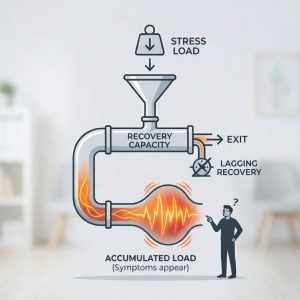
Most people assume: If I could just reduce stress, I’d feel better.
But stress is unavoidable. It’s part of being alive.
The real issue is that your body’s recovery systems are no longer keeping up with the demand being placed on them.
Here’s the math that nobody draws out for you:
- Stress loads the system
- Recovery clears the system
- When recovery lags, the load builds — and symptoms appear
Over time, even small things tip you over. A change in weather. A meeting that ran long. A food you’ve eaten a hundred times before.
That’s when reactions start to feel sudden. Confusing. Random.
They’re not random. They’re predictable accumulation — you just haven’t had a way to see it yet.
What the Symptoms Are Actually Saying
When regulation breaks down, your body finds another way to communicate.
Headaches. Allergies. Fatigue. Inflammation. Brain fog. Skin flares.
These aren’t isolated failures. They’re not your body attacking itself for no reason.
They are signals — from a system that can no longer compensate quietly.
Not punishment. Communication.
“I can’t absorb any more. Something has to give.”
What your body needs isn’t another suppression strategy. It needs baseline stability — a foundation that allows recovery to actually happen.
When that’s restored:
- Reactivity decreases
- Calm becomes accessible
- The body stops treating ordinary life like a threat
- Confidence starts to come back
Not because you forced it. Because the system finally feels safe enough to let go.
If You’ve Ever Felt Dismissed
If a doctor has told you:
- “Your labs are normal”
- “There’s nothing else to test”
- “You’re doing everything right”
…and your body has told you something different —
You’re not imagining it. You’re not weak. And you’re not alone.
You don’t need another label. You need a clearer understanding of how your system actually works — and what it’s been trying to tell you all along.
Because your body hasn’t been failing you.
It’s been sending signals.